OneTrust Consent Management for Android
4 minute read
The Android (Java) SDKAndroid (Java) refers to the legacy RudderStack Android SDK. Note that it will be deprecated soon.
For new implementations, use the Android (Kotlin) SDK instead.
lets you specify the user’s consent during initialization.
This guide lists the steps to develop a consent interceptor for the Android (Java) SDK and use the interceptor to initialize the SDK after the user gives their consent.
The Android (Kotlin) SDK does not have a dedicated OneTrust consent management integration
The new Android (Kotlin) SDK does not have a dedicated integration for OneTrust consent management. You can still use OneTrust — read the user’s choices from the OneTrust SDK and pass them to RudderStack as custom consent category IDs. See Consent Management in Mobile SDKs.
To implement OneTrust consent-based event filtering for cloud mode destinations without the Custom provider, add the
consentManagementobject within the context of your event payload.See Consent Management Support Matrix for more information.
Overview
The consent management is designed to be a filter for the event destinations and the natively added factories. Since the SDK initializes the native integration factories during the startup, you must first capture the user’s consent to the cookie categories.
You can add only one consent filter to the Android (Java) SDK.
For filtering, RudderStack uses the getConsentStatusForGroupId method of the OneTrust SDK.
Install OneTrust consent
This setup assumes the Android (Java) SDK and the OneTrust SDK are already added to your application.
- Add OneTrust Consent Filter to your
build.gradle(module level).
dependencies {
    // add other dependencies
    ...
    implementation 'com.onetrust.cmp:native-sdk:202301.2.0.0'
    implementation ('com.rudderstack.android.sdk:core:1.12.0')
    implementation ('com.rudderstack.android.consentfilter:onetrustconsentfilter:1.1.0')
    ...
}- Move the RudderStack initialization consent callback. The following snippet shows a sample application file highlighting the initialization:
class CustomApplication : Application() {
    var _rudderClient: RudderClient? = null;
    val rudderClient
        get() = _rudderClient
    private val oneTrustEventListener = object : OTEventListener() {
        override fun onShowBanner(p0: OTUIDisplayReason?) {
        }
        override fun onHideBanner() {
        }
        override fun onBannerClickedAcceptAll() {
            createRudderClientWithOneTrust()
        }
        override fun onBannerClickedRejectAll() {
            createRudderClientWithOneTrust()
        }
        override fun onShowPreferenceCenter(p0: OTUIDisplayReason?) {
        }
        override fun onHidePreferenceCenter() {
        }
        override fun onPreferenceCenterAcceptAll() {
            createRudderClientWithOneTrust()
        }
        override fun onPreferenceCenterRejectAll() {
            createRudderClientWithOneTrust()
        }
        override fun onPreferenceCenterConfirmChoices() {
            createRudderClientWithOneTrust()
        }
        override fun onShowVendorList() {}
        override fun onHideVendorList() {}
        override fun onVendorConfirmChoices() {
        }
        override fun allSDKViewsDismissed(p0: String?) {}
        override fun onVendorListVendorConsentChanged(p0: String?, p1: Int) {
        }
        override fun onVendorListVendorLegitimateInterestChanged(p0: String?, p1: Int) {}
        override fun onPreferenceCenterPurposeConsentChanged(p0: String?, p1: Int) {
        }
        override fun onPreferenceCenterPurposeLegitimateInterestChanged(p0: String?, p1: Int) {}
    }
    internal val otPublishersHeadlessSDK by lazy { OTPublishersHeadlessSDK(this) }
    override fun onCreate() {
        super.onCreate()
        setupOneTrust()
    }
    internal fun setupOneTrust() {
		// set up one trust,
        // uncomment the following line and pass the credentials
		// otPublishersHeadlessSDK.startSDK()
        otPublishersHeadlessSDK.addEventListener(oneTrustEventListener)
    }
    private fun createRudderClientWithOneTrust() {
        _rudderClient = RudderClient.getInstance(
            this,
            WRITE_KEY,
            RudderConfig.Builder()
                .withDataPlaneUrl(DATA_PLANE_URL)
                .withTrackLifecycleEvents(true)
                .withRecordScreenViews(false)
                .withConsentFilter(RudderOneTrustConsentFilter(otPublishersHeadlessSDK))
                .build()
            )
    }
    private val otSdkParams
        get() = OTSdkParams.SdkParamsBuilder.newInstance()
            .build()
}
Create custom consent filter
- Create a new Android library project.
- Add the following to the
dependenciessection in the module-levelbuild.gradlefile:
dependencies {
	   // add other dependencies
		...
    compileOnly 'com.rudderstack.android.sdk:core:1.12.0'
		...
}- Create a class to implement
RudderConsentFilterWithCloudIntegration:
public final class MyConsentFilter implements RudderConsentFilterWithCloudIntegration {
	@Override
	public Map<String, Boolean> getConsentCategoriesMap() {
		// return the category id to consent map.
		// The map should have the category id as key and true if consented,
		// false otherwise
		// Rudderstack SDK will filter out the destinations corresponding to
		// categories that are not consented.
	}
}- Attach
MyConsentFilterto the Android (Java) SDKAndroid (Java) refers to the legacy RudderStack Android SDK. Note that it will be deprecated soon.
For new implementations, use the Android (Kotlin) SDK instead. similar to the OneTrust consent filter:
_rudderClient = RudderClient.getInstance(
            this,
            WRITE_KEY,
            RudderConfig.Builder()
                // other methods
                .withConsentFilter(MyConsentFilter())
                .build()
            )
Additional settings for cloud mode
RudderStack supports OneTrust integration in cloud mode from Android (Java) SDK v1.12.0 and above.
You can specify the OneTrust cookie categories when sending events from your Android (Java) source in the cloud mode.
- Set up your Android (Java) source in the RudderStack dashboard.
- Connect it to a destination.
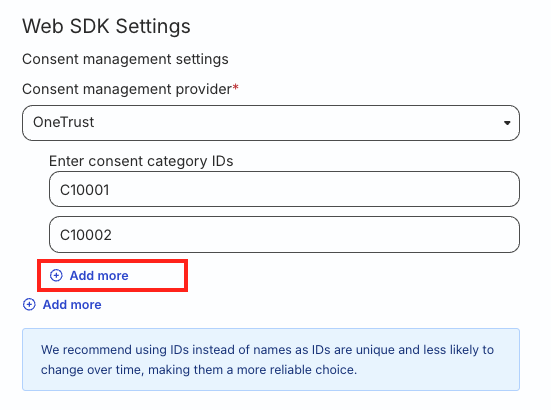
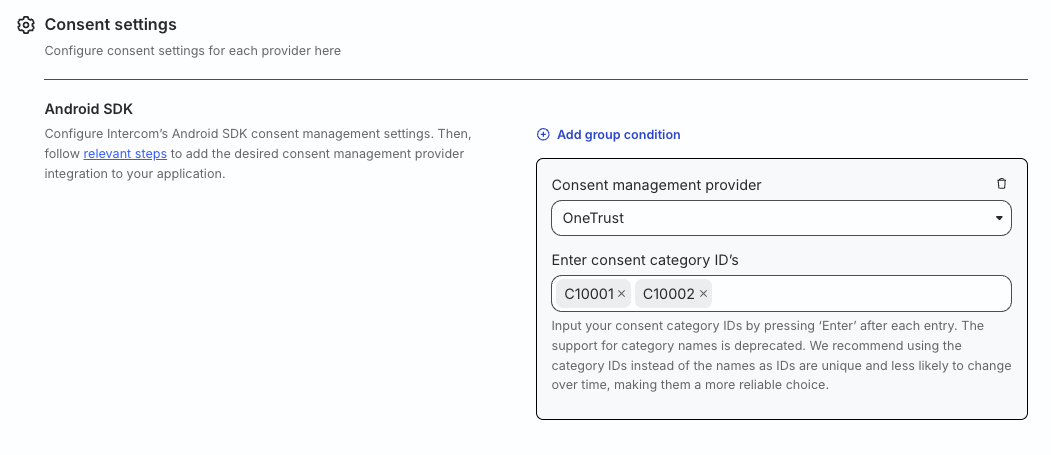
- In the destination settings, enter the OneTrust category IDs in the Enter consent category IDs field. You can specify multiple consent category IDs by pressing the Enter key after each ID:
You can find the category IDs in your OneTrust dashboard under Preference & Consent Management > Cookie Compliance > Categorizations > Categories.
Note that the settings for specifying multiple consent IDs vary slightly for some destinations. Click Add more after specifying each consent category ID.