The API calls to Google Ads will fail if you authorize this integration without the Standard or Admin permissions.
Data Manager API access
RudderStack uses the Data Manager API to manage Customer Match for this destination.
The API requires an additional OAuth scope when you connect your Google Ads account in RudderStack. See the below table for exact steps based on your RudderStack plan and integration setup:
RudderStack plan
Integration setup
Action
Free
New First-time setup
The Data Manager API is enabled for your workspace by default. Connect your Google Ads account and approve OAuth so RudderStack can call the API.
Free
Existing
Re-authenticate the Google Ads connection in RudderStack to grant the additional OAuth scope.
Re-authenticate the Google Ads connection in RudderStack to grant the additional OAuth scope, then contact RudderStack support to enable the Data Manager API for your workspace.
Setup
Set up and configure your Reverse ETL source.
In the Overview tab of the source page, click Add destination > Create new destination. You can also select an already-configured destination here.
From the list of destinations, select Google Ads Remarketing Lists and click Continue.
Specify a unique name to identify this destination in RudderStack.
In the Event delivery account section, click Select to choose from an existing Google Ads account from the list. You can also click Add account and authenticate via OAuth, by specifying the following settings:
Setting
Description
Account Name
Specify a unique account name
oAuth settings
Click Connect account, sign in with Google, and give RudderStack the required permissions to access your Google Ads account.
RudderStack automatically populates the Custom ID associated with your Google Ads account — select the relevant ID from the dropdown.
Turn on the Subaccount setting if you are using a Google Ads subaccount.
Note: See this guide for more information on subaccounts.
If Subaccount is toggled on, enter the Login Customer ID of the parent (manager) account associated with the subaccount.
Click Continue to configure the mapping settings.
Mapping settings
This section lists the settings to correctly map data from your Reverse ETL source to the Google Ads Remarketing Lists destination.
Select user list
In this section, you can create a new user list or use an existing one.
Create new list: Use this option to create a new list in Google Ads. You can specify the name and description of the new list.
Use existing list: Use this option if you have an existing list in Google Ads. RudderStack automatically populates this field with the relevant lists based on your specified connection settings.
Sync mode
RudderStack supports only Mirror mode for this integration.
Select list type
If you select the Create new list option, you need to select the type of list where you want to sync the data. RudderStack provides three options:
List type
Description
CONTACT_INFO
You can send email, phone number, and address information in this list
CRM_ID
You can send internal customer IDs in this list
MOBILE_ADVERTISING_ID
You can send mobile advertising IDs (IDFA/GAID) in this list
Note: If selected, specify the App ID of the mobile app the data was collected from.
For iOS, it is the 9-digit number at the end of the App Store URL, for example, 123456789.
For Android, it’s the package name, for example, com.sampleapp.samplename.
Map identifiers
In this section, you can map your warehouse columns to specific Google Ads fields that represent your audience’s identity.
The fields available for mapping depend on the list type you select.
Advanced settings
Setting
Description
Automatically hash PII data
When set to Yes, RudderStack hash-encodes sensitive user data like email, phone, first name, and last name in the SHA-256 format.
Storing sync logs and snapshot tables may incur additional warehouse costs.
Data normalization
By default, RudderStack automatically cleans and standardizes the data as prescribed by Google Ads.
After normalization, RudderStack validates each field before sending it to Google Ads:
If a field is determined to be invalid, RudderStack does not send it to Google Ads.
If all fields in a row are invalid, then the entire row is rejected and marked as failed
RudderStack first normalizes the data and then validates it, skipping any invalid rows. Then, it hashes the data before sending it to Google Ads.
Data hashing
The Automatically hash PII data setting lets you hash your user data before sending it to Google Ads. This setting is enabled by default.
Configure the setting to Yes if your incoming data is not pre-hashed
Configure this setting to No if your data is already hashed
Incorrect configuration of the Automatically hash PII data setting will result in failures.
If the Automatically hash PII data setting is configured to Yes and your data is pre-hashed, the event will fail.
If the Automatically hash PII data setting is configured to No and your data is not pre-hashed, the event will fail.
RudderStack rejects such events with a clear error message, for example:
Hashing is disabled but the value for field EMAIL appears to be unhashed. Either enable hashing or send pre-hashed data.
You will also see errors in the Events tab for cases that were previously marked as successful, but were effectively resulting in no matches, helping you quickly identify and fix any data quality or configuration issues.
FAQ
Why can’t I add a Reverse ETL source from the destination page?
The Reverse ETL feature supports only source-driven pipeline configuration. It means that you must configure a Reverse ETL source in RudderStack and then connect it to a new or existing destination. Note that this destination should not be connected to any other source.
From the dropdown, select the list type of data to upload.
Upload the CSV containing the user data. You can also download the template and upload the data.
Click UPLOAD AND CREATE.
What are the account permissions required for the Google Ads Remarketing Lists integration?
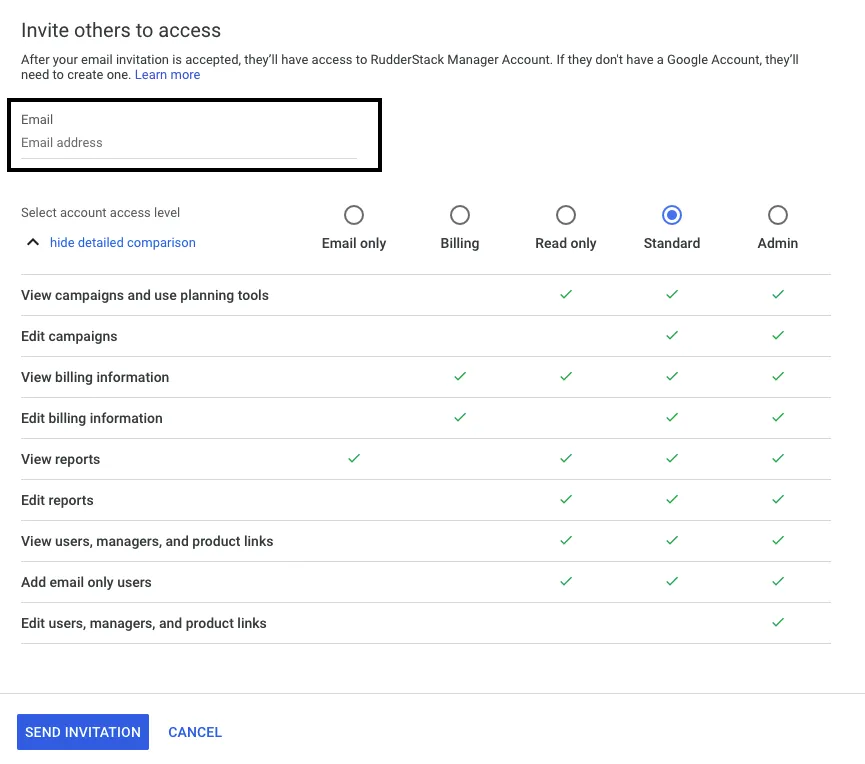
Make sure the customer account used for OAuth verification adheres to Google’s Customer Match policy and has Standard or higher (Administrative) access level permissions.
For more information on the access level permissions, refer to this Google Ads support page.
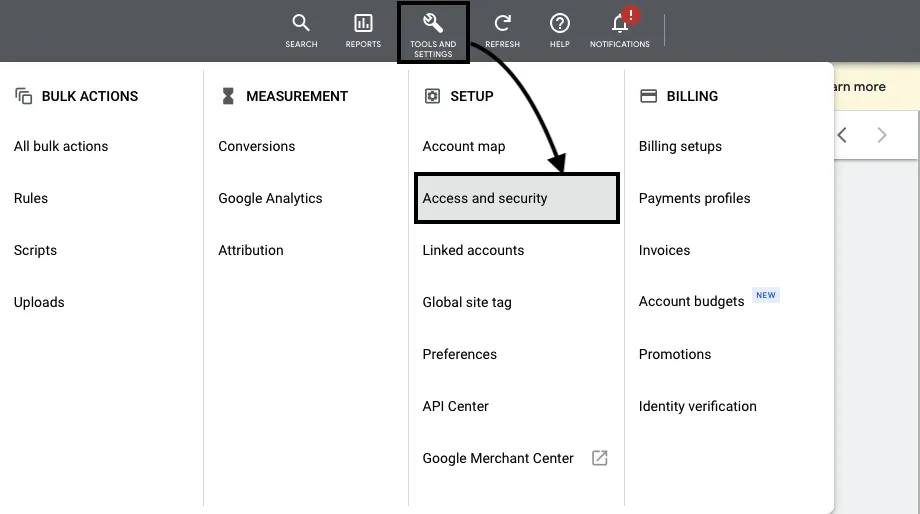
Follow these steps to set the access level:
Sign into to your Google Ads account and go to TOOLS AND SETTINGS > Access and security:
Enter the email address of the account. From the list of permissions, select Standard or Administrative. Then, click SEND INVITATION:
The account will have the required access-level permissions once they accept the invitation.
Why am I getting a 400 Bad Request error message while setting up the Google Ads Remarketing Lists destination?
If you get a 400 Bad Request error while configuring the destination, make sure your customer account is allowlisted and configured to have Standard or Administrative access levels in Google Ads.
See the above FAQ for steps on setting the access level permissions for the account.
Questions? We're here to help.
Join the RudderStack Slack community or email us for support
This site uses cookies to improve your experience while you navigate through the website. Out of
these
cookies, the cookies that are categorized as necessary are stored on your browser as they are as
essential
for the working of basic functionalities of the website. We also use third-party cookies that
help
us
analyze and understand how you use this website. These cookies will be stored in your browser
only
with
your
consent. You also have the option to opt-out of these cookies. But opting out of some of these
cookies
may
have an effect on your browsing experience.
Necessary
Always Enabled
Necessary cookies are absolutely essential for the website to function properly. This
category only includes cookies that ensures basic functionalities and security
features of the website. These cookies do not store any personal information.
This site uses cookies to improve your experience. If you want to
learn more about cookies and why we use them, visit our cookie
policy. We'll assume you're ok with this, but you can opt-out if you wish Cookie Settings.